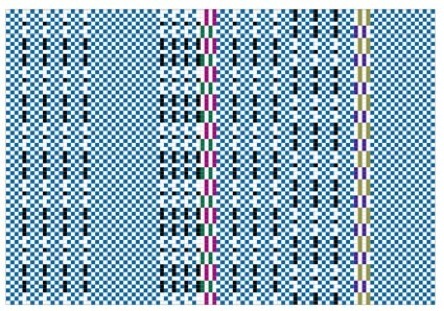
stripes: by adding surface interest of a double weave or crammed threads to a plain weave background
tactile interest is added, and more vibrant colours can give a lively effect.

stripes: by adding surface interest of a double weave or crammed threads to a plain weave background
tactile interest is added, and more vibrant colours can give a lively effect.


Stripes are a very familiar cloth design, but adding a little bit of extra interest brings added value to the textile. The paper design was made with this technique in mind: background stripes in plain weave in a dark subdued colour with accent stripes in a double face in more brilliant colours. For the stripes In the hand woven sample twice the amount of threads was used in the reed so that the stripes would visually lie above the plain weave background giving surface interest. Eight shafts were used for the plain weave when 2 would suffice to spread the threads evenly in weight. The stripes only need four shafts, but by using two groups of four shafts in later weaves the stripes could be manipulated separately.
design made by using off cuts of coloured paper
cloth woven with blue weft
Weaves by Wendy



A sample to show how the eventual production design looked. All the colourways had black and white dividing stripes in a yarn twice as thick as the basis cloth.There was then no longer a need to cram finer threads in the reed.
In the two samples below the same weaving technique was used for the thin brightly coloured stripes but this time on a neutral background. The advantage of a double face stripe is that the colour is intense. It also adds tactile interest like ribbons on the surface, on both sides of the cloth.


The black threads float over the plain weave background in stripes of varying density. Two bright coloured decorative stripes have been introduced to add a colour accent. The denting gives the clue to success. This is a delicate balance between spreading the black threads evenly but not having too many in a dent to cause rubbing and piling of the fibres. The plain weave is the same density over the whole width but absent from the accent rib stripes which are crammed in the reed 4 per split.
**|**|***|**|***|**|**|**|**|***|***|****|***|**|***|**|***|**|***|**** |**|**|**|
Denting :- with a 12 split per cm reed, In the first stripe on the left, the black thread was placed in alternating splits,The following plain stripe: two per split. In the darker stripe there is an extra black thread in every split, thus three in each opening. For the accent stripe 4 threads per opening. Surprisingly this caused no tension problems in production using only one beam.